


Two weeks ago we welcomed baby Ryan into our family. While I am enjoying snuggling with him and spending time with my other two kids, I have some special guest bloggers scheduled to share some great posts with you! Today I am so happy to have Katie from Playing With Words 365 sharing a great post with us about toddler language development. Welcome Katie!
The toddler years are my most favorite. Your little ones are learning SO MUCH every day and it is so amazing to watch. They are discovering their world around them and learning how to maneuver it.
This time of development is also huge in terms of speech and language development. Their infant babbles are now turning into real words and they are going from single words to putting words together. It can also be a challenging time, however, because often times toddlers understand much more than they can say and therefore they can become frustrated sometimes...which can lead to tantrums and tears (for both your toddler and yourself!)
So how can you help your toddler learn language and foster a strong communicative bond?
Here are five things you can do to help your child's speech, language and communication development:
Slow Down
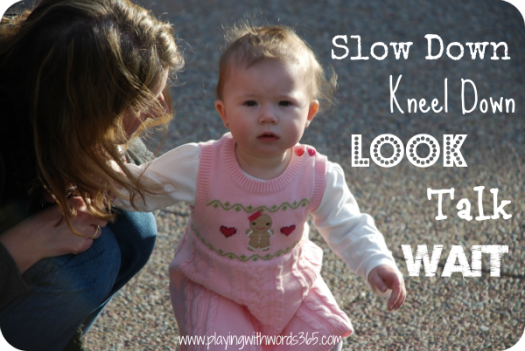
My first tip may seem obvious, but slow down. I mean this in a few ways. First of all, life can get busy and we can sometimes sit down at the end of the day and hardly remember what we did because it was all done at lightning speed. Make sure to try to slow down when you can and really talk to your little one during those routines that you often don't even think about. Children learn language in everyday moments. Everyday routines. Diaper changes, bath time, meal time...these are all so routine yet some of the best times to slow down and talk to your child. These are the moments he is learning the most.
Also, slow down your own speech. This is especially important if your toddler is struggling with speech and language development. I have met many a parents who bring their child into me for an assessment and they are speaking to me at such a fast rate that I have a hard time keeping up. Though some of this is due to being concerned for their child and nervous about the evaluation, more often than not they admit to me that they often speak very quickly. In this fast paced world full of cell phones, computers, "on demand" TV and such, we are all moving so fast and talking so fast some little ones have a hard time keeping up. So...slow down your pace in life and your speech.
Look at Your Child (And Get Down at His Level)
This may seem obvious but when you really slow down (remember how I mentioned that one already?) and take a look at the way you communicate to your little one, you may be surprised how often you throw out language to your child while they are turned away from you or while you are turned away from him. If you want your child to learn language and be a better communicator, you need to take time to slow down, look at your child when you speak, and when possible, get down at his level. This helps your child focus on you and your message. This helps phase out the distractions around him like toys, noise, and other children.
Wait
Fellow SLP Kim over at Little Stories has a fantastic series on the importance of waiting. In today's world, it seems we expect everything in a millisecond. We carry smart phones that can do a Google search and give us what we want almost immediately. But our kids don't learn language this way. They need us to help them, and they need us to wait.
In terms of your little one's communication skills, make sure you take time to wait for your little one to respond to you. When you ask a question of him, wait. When you ask him to do something, wait. Sometimes, we don't realize it but we are not allowing our children to take part in important learning experiences because we are too busy responding and doing for them, rather than waiting to see if they can do/see/say it without us. Read Kim's post at Little Stories to read more about the importance of waiting.
Stop Counting and Start Communicating
Years ago I was doing an assessment on a sweet little boy whose grandparents took care of him during the day while the parents worked. Both grandparents were present for the assessment as well as the mother. During the interview portion of the assessment (where I try to get to know the family, the child, and the routines of the family) the grandmother proudly told me "We always count the stairs as we go up and down every day. We do lots of letter and number activities and he knows all his shapes and colors!"
As awesome as it was that this child could identify all his shapes and colors at age 2 1/2, he could not communicate his basic needs and wants. Yes, he could count well but he wasn't asking many questions to gain information about his environment which means he was missing out on a lot.
I know that this is an exciting time in your child's development. They are little sponges that seem to soak up so much. But right now isn't the time they need to master letters, numbers, and shapes. By all means...please expose your child to these things in natural experiences! Let colors, numbers, shapes, counting and letters slowly become a part of his vocabulary but we don't want her vocabulary only made up of these. Instead, remember to communicate about all the things you see in her environment. When she points at things, talk about them. Ask her questions and wait for her answer. Narrate her play sometimes and narrate your own movements. Talk to your child don't just count the stairs.
Rethink Your Toys
Children learn language all day every day through all your normal daily routines. They also learn and use language within their play, which means that it is a good idea to take a look at the toys you have out for your child to play with. I have some general tips for you:
- Get rid of all (or at least most of) the bright colored, plastic toys that light up, talk, and play music. You know the ones....the box says "Encourages Color, Letter and Shape Identification!" and this of the sort. These toys "do" a lot on their own rather than your child doing the doing. I talk about these a bit on my own blog as does Kim over at Little Stories. Check her post on SCLANS and mine on What Your Toddler Really Needs to Learn.
- Make sure you have basic toys that allow for many open ended play opportunities. These toys also allow for many many many more language opportunities than those types of toys I'm talking about above. Some ideas of what I am talking about can be found in my Best Toys for Speech and Language Development Series.
- Consider utilizing a toy rotation in your home. I just started this and wish I had done this YEARS ago. Read more about why you should start your own over at Little Stories.
What do you think? Are you doing these things already in your home? How do YOU encourage speech and language development in your children?
Thanks again Kristina for this fantastic opportunity to guest post here at Toddler Approved!
For more information on speech and language development, you can check out my series on Speech and Language Development: Birth to 5 and my Speech and Language 101 page. If you have a toddler who is struggling with his speech and language development, you might want to check out my How to Help your Child Talk page.

Katie is a a mom to three little ones (ages 5, 3, and 6 months) and a licensed and credentialed pediatric speech-language pathologist (when she finds the time). She blogs over at Playing With Words 365, sharing information about speech and language development, intervention strategies, therapy ideas and tips, and shares a little about her family and their life too. You can follow along on Facebook or Pinterest for more speech and language ideas and tips.




Baby sign language also helps a lot. My daughter was able to communicate with us for things like milk, more, all done, diaper change, book, etc, before she could form words to express them. I started using the words right when she was born then a few months later incorporated the signs. I don't remember exactly how old she was when she started signing to us, I'm thinking maybe around a year old? As a toddler there were less tantrums because we could understand what she wanted. She also had a high vocabulary early on and I do believe it was because of all the regular conversation I had with her as an infant, encouraging babbling (stoping what I was saying and listening to her),reading to her and the sign language.
Baby sign language also helps a lot. My daughter was able to communicate with us for things like milk, more, all done, diaper change, book, etc, before she could form words to express them. I started using the words right when she was born then a few months later incorporated the signs. I don't remember exactly how old she was when she started signing to us, I'm thinking maybe around a year old? As a toddler there were less tantrums because we could understand what she wanted. She also had a high vocabulary early on and I do believe it was because of all the regular conversation I had with her as an infant, encouraging babbling (stoping what I was saying and listening to her),reading to her and the sign language.
What about when your toddler starts to repeat everything? Do you have any articles on that subject?
My child has a speech impediment, and I need to help her get it fixed. Thanks for the information about how you should rethink your toys so that you child can learn how to do things on their own. It would also be smart to get help with your child's speech therapy from a professional. communikids.com.au
Thank you katie,
i was so worried about my son. He only talk when he need something like Choclate, food, mobile etc. It was my mistake that i was offer everything infront of him before he even need to ask me. But i feel confident after reading your blog. Once again thank you.
Ammu
Katie, these are some really good tips on how to help a toddler learn to speak. When my little brother was a toddler his nickname was "Gerald Mcboing Boing" and that was because he was exactly like that cartoon character. He would only communicate with us through noise and sound effects. My parents were pretty worried about him and took him to see a pediatric speech therapist and found out that his tonsils were inflamed and it was making it so he couldn't talk. After he got that taken care of it was easier for him to talk, however, he still makes the noise as a teenager. abcpediatrictherapy.com/therapy-services/speech-therapy/
Thanks for such a wonderful article. One point that really touched me is 'stop counting and start communicating'. Many parents unintentionally end up in one way conversation with their child and forget to allow their child to communicate. They want to make their children Einsteins from early age but forget to stimulate their minds and develop creativity and inquisitiveness in them. Definitely sharing this wonderful article..:)
So helpful, thanks. Will definitely be sharing this with parents.
Thank you for the post. very helpful.
i have 25 month old baby girl and i didnt read any books for her till today.
can someone suggest me some books that I can start reading for her? Thank you for suggesion
Wow, what a nice tips to boost toddler communication skill. I have a 17-month toddler who's able to communicate a little. I like to repeat some simple words and give her time to repeat. Sometimes this little things helps on her word recognition. Naming each of her plush toys a cute name that's related to its real animal name also helps, because she will then try to point out to each toys and say its name.
That really struck a chord with me- a family member always commented on how a certain cousin could count and identify letters etc earlier than my child. When she finally got to see my child, she was stunned at how well she could articulate herself- did she know all the letters? no, but man she could tell you a story or two..
We talk constantly during the day and it is fantastic.
Other wonderful ways to support language skills are to read to your child often and sing with them often. When reading a familiar rhyming book to your child leave out the last word in the sentence and give them the opportunity to fill in the blank. Even if they aren't saying the word out loud yet they are most likely thinking it. Audiation (hearing the word in your head) is an important step in language development.
I was an Early Childhood Teacher for many years. My main concern is seeing babies and toddlers trying to talk with a dummy in their mouth. How can they possibly form words correctly with this obstruction? The dummy should be only used in the cot when the child is sleeping, and left there when they wake up. Everywhere I go these days I see young children sucking on a dummy and trying to speak to their parent, with the result that many words are unintelligible.
If you have any concerns about your child's speech/communication, speak to your pediatrician and specifically ask for a referral to a speech-language pathologist. While articles like this can be helpful, SLP's are the experts on recognizing each individual's needs and tailoring a treatment approach specifically designed to meet those needs. No child is too young or too old. If you feel there is a problem, ask!
Thank you Katie. I found this very helpful. My 32 month old grandson speaks pretty well, with some little speech quirks. (eg, glottal noises when s is at end of a word, this is improving). He doesn't see TV or DVDs, so all his speech is gained from his contact with his family, friends and once or twice weekly day care. He has lots of books read to him, and he chooses them often, and can tell stories. However, It is good to see your advice, as I see quite a lot of other small children through my church playgroup, where I am a volunteer. I will be sending this page to the mothers of the group. It is wonderful to have so many blogs and ideas available on line.
Hi there, my 2 years and 9 months old started talking when he was like 18 months said 'see you' auntie for 'Ti Ti'. All of the sudden he stopped speaking and first me and my husband didn't notice because he is a happy baby and we believe when he is ready he will talk. However, now he is 33 months old and he can says A to Z and 1 to 10. 'Apple, ball, cat, goat' he doesn't call me mama or dada to my husband. I went to see developmental and speech delay therapist and she tested him by spending a few times with him. Asked me to filled out three booklets which were full of questions about behaviors, physical movements etc. I got results back and the doc told me he is a normal kid but she is a bit concerns when we call him he looks sometimes and he doesn't look up often too. He seems not to care about what is going on around him too. I m really concerns and worry sick. My husband and I work full time and our mistake was we let him stay with nanny and nanny gave him too much iPad and offer everything in front of him before he even need to ask. So now I cut back my work hours and spend more time with him. I feel so guilty as he was a very happy bubbly kid and now I feel like he shut off and close up. Any idea would be appreciated and this is a good site. I really thankful that I found this site. Many thanks in advance. Carol
Hi carol, I don't want to scare you and I'm sorry if I do. Have you had him tested for autism? I have an adult child with high functioning autism. This happens with autism that they learn things and then regress. The sooner you find out and get him the treatment/ therapy he needs the better be will be. I didn't listen to everyone when they said oh he will be fine I went with my motherly instinct and because of that my son at 20 owns his own lawn service,drives etc. He still has some challenges but with more guidance and learning he will be ok. 🙂 good luck
If you did have him tested already and it came back as no autism it may be because he is to young for them to Dx as of yet if he is. There is a ton of things you can find online that can help you to help him.
Hello,
firstly no need to panic! i am an early childhood educator and i would advise you get his ears checked.once you have results take it from there!
Bibi
x
Fantastic article! I think we often forget how our size can be intimidating to children and make it difficult to engage. Sharing today on the Homegrown Friends FB page.
Thank you for this reminder! I often have to consciously slow down and stop multitasking to stop and have a chat with my little ones. I have shared in on my Facebook page and I am sure many will benefit from it. Kristin @ Heart of a Farm Girl
Thank you so much for this easy to follow through with post! I often have to consciously slow down and stop myself from multitasking to have a good chat with my kids. Thank you for the reminder! I have shared your post on my Facebook page and I am sure many will benefit from it. Kristin @ Heart of a Farm Girl
Fun activities are very important for kids
lessons from kids
It is interesting, I always teach to my child with the use of toys because they can remember it very well. I should try other tips as well. Old fashioned luggage tags
Wonderful tips that I'm sure will help others — pinning to my parenting tips board!
Very helpful information shared though!! To improve toddler learning ability I think following such ways will be highly effective. I've indeed great time studying such awesome piece of allocation. Thanks.
I liked this post! It has some good tips. It's interesting because we forget how much babies and toddlers imitate adults. The way we respond to things, how we talk to them and to other people are good reference too. Also repetition is key. A problem that I face is comparing our son to other children his age, and that's a bit unfair being that every child develops at their own time. I think we expect too much from babies and don't give them enough time to be babies.
the main toys we have in our home do not require batteries. we have 1 toy that does the alpha etc..and he doesn't' like it, he is STILL speech delayed. He's in speech therapy . So while these are GREAT ideas, they have not worked for our son. we also read to him daily, play with flash cards.. the only thing that helps him really communicate right now is sign language. He is not special needs..just speech delayed. I hope through therapy this improves soon.
the main toys we have in our home do not require batteries. we have 1 toy that does the alpha etc..and he doesn't' like it, he is STILL speech delayed. He's in speech therapy . So while these are GREAT ideas, they have not worked for our son. we also read to him daily, play with flash cards.. the only thing that helps him really communicate right now is sign language. He is not special needs..just speech delayed. I hope through therapy this improves soon.
Same for us. We have done everything right. No noise/light up toys or electronics–not even tv. Lots of books–both reading off the page and just talking about the pictures…. I mean my son looooves books he wants to read for hours and hours and always has been since he was an infant. He is a little over 2 and a half and just starting to put 2 words together. He is mildly speech delayed and we are doing speech therapy. He is picking things up very quickly and naturally. I think some children just develop at different paces in certain areas. He has always been very coordinated with his gross motor skills and has incredible rote memory. He learned his alphabet (uppers and lowers) in a matter of days. It was an accident, really. He showed interest at the symbols on his books and I just went along with it. All this to say that I think lots of children who are "delayed" in certain areas tend to be way ahead in other areas. And it's a matter of time and intentionally getting them to switch their focus to the area that is behind to get them where they are "supposed" to be.
What helps us is just keeping a running commentary on life. Paying attention and talking to little ones all the time. It's sad to see so many blank faces children in the stores with parents who are talking on cell phones or silent, ignoring them.
love that & can relate, as an older grandma, this is how it was in the 'Dark Ages' Just TALK! They get it!
We've done all of this with my 14 month old daughter, and she talks more than most 2 year olds I know. Toys with batteries weren't introduced until she was 1, and she can only have them for about 10 minutes a day. It's great! Beyond "mommy" and "daddy", she knows animals, the sounds they make, what she wants, her toys, and can almost always communicate with WORDS (not just pointing and grunting) what she wants. If she's hungry, she'll say, "ninner!" (dinner) She can also tell us what she wants to eat… "berries", "milk", pasta", "betty" (spaghetti), "peas", "beans", etc… At last count, she was up to about 40 words, we've just stopped counting. Great post!
Great ideas!
Nice ideas! I didn't even think about the toy one until you mentioned it… but as it turns out, he PREFERS the quiet toys. the cars that dont make noise are his favorite. he'll push them and say vroooooom! <3
thank you…the suggestions are really superb…I use to follow some of above..but my sun don't listen to what we are saying.he just let go the things.all naughtiness is exist in him.fed up.suggest any program which can make him understand the value of good and mannerly behavior.
Know what my mom did to help my speech develpment? She talked to me. A lot. She also never used baby talk with me.
Good post and yes, I'm already doing these things with my child. I'd like to see more specific suggestions for a child with special needs (or maybe you address this in another blog? This is the first time visiting your site). My son is 2 and has Down Syndrome.
Thank you for sharing all of this wonderful information.
INCREDIBLE THINKING!! You did really making sense. My little baby girl like different things to do and I think this will be enjoyable for me also when I'll see she is making this.
Nice post……………..thanks for sharing me
Nice post and thanks for sharing me this info.
This is very amazing post i really like this and keep posting such a nice type of posts.
And thanks for sharing this……
This is nice post i really like this and thanks for sharing me such a nice info.
I love this! Easy, simple and beautiful!
very nice post this is very cute and beautiful post and thanks for sharing this.
This is very nice and beautiful article i like it.
Oh boy, where to begin. My 20 month old son is not talking at all. He was never a babbler (think I just made up a word) as a baby, come to think of it he was really a quiet baby, not very vocal at all. It never really bothered me because I didnt realize it wasnt normal but now that I am seeing my friends babies babble nonstop Im starting to feel like I missed a huge red flag. He knows a couple of words in sign language but we have pulled away from teaching him anymore words and reinforcing the ones he knows because I want him to verbalize them instead. He still to this day does not babble all that much, a few seconds here and there during the day. The only thing he does "say" is mamamamama for everything. If he wants milk, a toy, something to eat etc all we can get out of him is the mamamama. When we try to withhold an item from (as suggested by his doctor) him until he says the word he just gets incredibly upset which to me only seems to prevent him from learning because he isnt paying attention to us any longer. His doctor just told us not worry and that he is just too loved (we anticipate and give him everything he wants to often) which I guess is true since he is an only child and our miracle baby (I lost our first 3 in pregnancy) but we have always been very verbal with him. I have always told him what I was doing as I am doing it etc. We read for 10-20 min to him every night and throughout the day (he would have us read to him all day if he could) and he is often found in his reading corner looking at his books. People keep telling me to relax, that he will talk when he is ready but I am getting to the point of being distraught by his lack of speech. The only person that seems to agree with me is my aunt because she too sees us being very vocal with him. We ask him questions, describe things to him, etc. I dont know what else to do.
My son did the exact things you are describing at the same age. Including the mamamama, knowing a few signs, not much babble, reading, getting upset when forced to talk, all of it. My son also refuses to talk when teething. (which I'm told is really odd) He is also my miracle baby and I anticipated most of his needs. I stopped giving him everything before he asked. I now make him get my attention a lot of the time. It was really hard to make that change. He's now almost 2 1/2 and talks about half the time. He asks for specific things like juice, cheese, and a car. He just started counting a lot. My son is still not much of a babbler and still goes silent for a few days when his teething gets bad. He also gets more chatty after being around other children, so we go to the park a lot. I'm not any type of expert by any means, but your son sounds a lot like mine did. I had to write and tell you really dont worry he'll talk.
My daughter was the same way and we had her hearing tested. It turned out she had a hearing deficit because of enlarged adenoids not letting fluid drain from her ears. The only thing she said forever is botboo. She will be four next month and is doing great.
Samantha, I am happy to say that he is finally at least babbling non stop. we have gotten him to at least say nana (for banana) but he will only say it when we tell him to. I am working myself up to forcing him to say what he wants.
Cassandra, that worries me a bit because one day he was babbling to himself and the way he "said" something made me think he isn't really "hearing" himself if that makes sense. I'm not even sure what it was but it made me stop what I was doing and watch him for a bit while he played. He has an appt. this Friday with his doctor so I will be sure to bring it up to her.
Hi Samantha, Funny because I´m going through the exact same thing with my 20 months old boy, who I fought to conceive for at least 3 long years. I completely understand your concern and how much you want to protect him, my husband and I both work and I travel almost every week, so Dani used to spent all his time with the nanny watching tooo much TV, now we are facing all these fears about him not speaking that much but he started attending to school from 9 to 3 a month ago and he loves it, even though he does not speak at all to them he plays and interacts a lot with the other kids and once he gets back home he has started babbling a lot more with new sounds, they are just sounds but it´s better than nothing I guess. I took him already to two therapist and they both said he´s very spoiled and stubborn and for sure that´s preventing him to learn. Thought about taking him in for therapy but we tried twice and he hated them all and cried the entire time which for sure will not let him learn anything so my pediatrician recommended to give him time and focus on him to interact with the other kids in school and follow instructions. I recommend you to do the same, I know it´s not easy to give them time and we would like to just have a magic pill to make them talk but at least there´s other moms out there like you sharing their stories and that helps me to understand that my problem is not unique and for sure is not so big. Good luck and thanks for sharing!
When my now grown son was a toddler, he tried to say things, but no one understood him but me. My neighbor suggested we not give it to him till he "talked" . Problem was he was trying he just wasn't able to speak so he could be understood. We found out that he couldn't hear properly. He was repeating what he was hearing, he just wasn't hearing what we were really saying. Once he had tubes put in his ears, his speech improved a lot. Although he did require speech therapy , but he was three before we made this discovery. I know this isn't always the problem, but my son also had many ear infections over the years. Not sure why it took so long for the pediatrician to refer us to an ENT. Dr. Just a thought.
Thanks for your resourceful post. I'll apply your ideas on my little baby girl.
It is interesting, I always teach to my child with the use of toys because they can remember it very well. I should try other tips as well.
My 16 month old has zero words yet. He understands SO much and follows commands very well. I am doing most of what you mentioned but I certainly found areas to improve on. I'm trying not to get worried about his progress, and appreciate the help I've found in your site. Thank you!
My son was a preemie born at just 29 weeks and he is now 2, my question is how do I get him to play with other children his age? He will play with his cousins who are all older than him by at least a year or more and he loves interacting with the adults in the family and strangers as well, but when we are at a friends house and there are other little ones there that are his age he really doesn't want anything to do with them. It's not as if they are strangers either, is there anything I can do?
I think that's pretty normal. My 2.5 isn't interested in kids under 5, and my 5 year old has always preferred playing with older kids too. Now that he's in kindergarten, he'll play with his classmates, but in preschool he didn't have any friends. Even now, he tells me some kids his age are too babyish, even though he plays with his brother.
I'm struggling with that problem with my son that is 2 and a half. The only word he says is "no" and a while back he started imitating the sound of some animals. he's being followed by a team of specialists and i try to do most of the thing you talked about. Still, his progress is very slow and it really worries me. i really enjoyed your post. Thanks!
Hi there! I have a boy and a girl and they're 2 and a half. I can see a lot of differences between the two: she picks up everything very fast and he is a bit slow. His language developement really worries me and I try to do most of the things you say… Still, he only says 'no'.
Great post! My little guy (19 months) is slower to talk than his big brother was, so I'm trying to pick up as many tips as possible!
Allison, if I said to not buy them at all, I'd be a *little* hypocritical. 😉 Though I have personally only bought a couple of these for my own kids (I think maybe 2??) They have gotten several for birthdays and Christmas. We have donated MANY of them, but there are a couple my kids actually do enjoy. Like the Leapfrog Laptop and the kids digital camera and this one drum toy I got my daughter when she was like 4 months old that both my kids AND my nephews LOVE. OH and this karaoke one by a brand I typically HATE but the kids like it 🙂 When we use our rotation though, they only have 1 at a time to play with anyway!
Thanks for the comment and feedback!
Great post! I love that you shared the specifics of why bright and noisy toys aren't ideal instead of flat saying not to buy them. I love the practical ideas you offered.
Thank you for your post! Really helpful advice! My kids are not this age anymore but I love how it's so specific and doable.
Thank you Pragmatic Mom!
Simple, so right, and useful! Awesome! 🙂
Thanks Kim! 🙂
Great ideas but I am surprised that reading wasn't in the top 5. I am an early childhood educator who is also the mom of a very verbal not yet 2 year old and I think the most important thing we did to foster her language development was read to her. I think that should be at the top of the list, in fact. She learned incredible amounts of vocabulary from books that she's not exposed to often in regular life as well as concepts, syntax, grammar, idioms, phrases and countless other things.
Hi there! Yes, reading is VERY important. On my blog, I talk a LOT about the importance of reading. My hope for this post was not to list all the ways (or even the *best ways*) to help your child's speech development, but rather to point out things I think people don't think about as much but can make a big difference in a child's communication. I feel that reading is suggested a lot…at the pediatricians office, parenting articles, blogs, etc but what i don't see as much are people talking about slowing down, waiting, and getting back to basics in the toys we offer our children. This by no means was a comprehensive list but I hope some people find it helpful 🙂 Thanks for the feedback!
Actually , reading to a toddler is an old school way of teaching. Brush up on your techniques to better help your pupils.
Wow Danielle, was that necessary? I completely understand Katie's point of her article so this is aimed at you and not her. I want to point out why I agree with The Davis Family. I too am a teacher but am not pushy or overly teachy with my 23 month old. I have read a few board books to my daughter about 5 days a week–perhaps about 10 minutes worth of reading a day–and then any other books that she asks me to read. Not as much as I would like but my daughter has gained concepts I would never have expected by age two..few,many, circles, round, counts to 2 and understands what it represents. I have not explicitly taught these concepts. She picked them up from the books that she chooses. I'm not saying she's a genius. I'm just saying that books will never be an old school way of teaching. Check the research. JenL
Jen L- I agree with both you, The Davis Family, and Katie. Reading is such an important way to foster communication in toddlers and is in no way "old school!" Your daughter is lucky to have a mom who spends so much time helping her foster a love of learning in so many ways!
I too am surprised that you consider reading to a child old fashioned,whether it's at home or in the classroom Danielle.
I agree with the post on all points especially when you say to get rid of the noisy "educational" toys ! Most toys requiring a battery to operate are totally unnecessary in my opinion. (I'm a Mum of 4 and early years teacher).
Old school? We read about 5 books/day to our 20 month old and his verbal skills are outstanding, he's up to approx. 40 words (yes I keep track) and 2-3 word phrases. We started reading to him in the womb and I think his verbal skills are a reflection of reading. Not old school at all!
Reading isn't old school at all! We read to our 20 month old about 5 times a day and he says about 40 words, many 2-3 word statements (yes I keep track.) We started reading to him while he was in the womb and most of his Christmas presents are books! I attribute his verbal skills to how much reading we do
As a toddler teacher I agree with you. Reading is vital for language development. And talk to, rather than at, children. Love the slow down as well. It takes a toddler time to hear, process, and react to verbal instruction.
This is a GREAT post. I totally agree. Pinning it.
Thanks Susan! 🙂
This is a fantastic post, really helpful. 😀
I am so happy you find this helpful! Let me know if you have any other questions or comments!
Simple, so right, and useful! Awesome! 🙂